If you are a Canadian permanent resident and you are currently outside Canada without a valid Permanent Resident (PR) card, returning to Canada can become complicated—especially if you plan to travel by commercial transportation such as an airplane, train, bus, or boat.
In such situations, you may need a Permanent Resident Travel Document (PRTD).
A PRTD is an official Canadian immigration document that allows a permanent resident who does not have a valid PR card to travel back to Canada by commercial carrier.
This guide explains what a PRTD is, who may need one, eligibility requirements, the application process, residency obligations, and important considerations before applying.
What Is a Permanent Resident Travel Document (PRTD)?
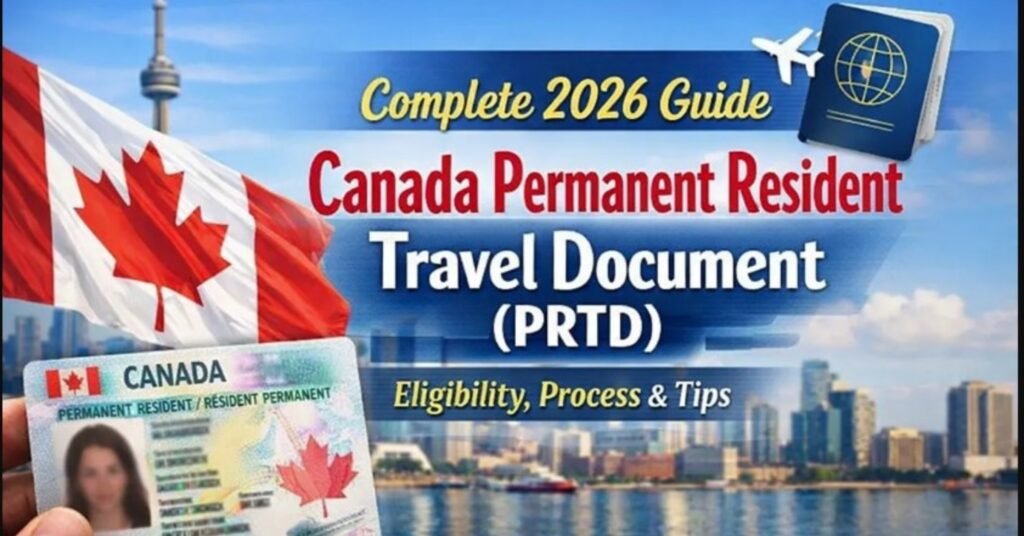
A Permanent Resident Travel Document (PRTD) is a temporary official document issued to Canadian permanent residents who are outside Canada and do not have a valid PR card.
Its primary purpose is to allow an airline or another commercial transportation company to recognize that you are a Canadian permanent resident and can travel to Canada.
If you are outside Canada without a valid PR card and intend to return by airplane, train, bus, or boat, you generally need a PRTD to board the commercial carrier.
A PRTD is generally issued for a single entry, although multiple-entry PRTDs may be issued in certain circumstances.
Who Needs a PRTD?
You may need a PRTD if:
- You are a Canadian permanent resident.
- You are currently outside Canada.
- You do not have a valid PR card.
- You need to return to Canada using a commercial carrier.
- Your PR card has expired.
- Your PR card was lost, stolen, or damaged while you were outside Canada.
IRCC specifically states that permanent residents outside Canada without a valid PR card can apply for a PRTD to return to Canada.
Example
Imagine you are a Canadian permanent resident living in Canada but travel overseas to visit family. While abroad, your PR card expires.
You still have Canadian permanent resident status simply because your PR card expired. However, if you want to fly back to Canada, you generally cannot board the flight without a valid PR card or PRTD.
In this situation, you may need to apply for a PRTD from outside Canada.
What Happens If Your PR Card Expires?
One important point that many permanent residents misunderstand is that an expired PR card does not automatically mean that you have lost your permanent resident status.
PR status and the PR card are two different things.
A PR card is evidence of your permanent resident status and is commonly used when travelling. However, the expiry of the card itself does not automatically terminate your PR status.
If you are outside Canada when your PR card expires, you may need a PRTD to return to Canada by commercial transportation.
Once you return to Canada, you can apply for a new PR card.
PRTD Eligibility Requirements
To apply for a PRTD, you generally must:
- Have Canadian permanent resident status.
- Be outside Canada.
- Not have a valid PR card.
- Intend to return to Canada using a commercial carrier.
- Demonstrate that you meet the applicable permanent resident residency obligation, or provide evidence relevant to an applicable exception or consideration.
The residency obligation is particularly important because IRCC may assess how much time you have spent in Canada and whether you have complied with the requirements for maintaining permanent resident status.
Understanding the PR Residency Obligation
Canadian permanent residents generally need to be physically present in Canada for at least 730 days during the relevant five-year period to comply with the residency obligation.
However, certain time spent outside Canada may count toward the residency obligation in specific circumstances.
For example, depending on the circumstances, time outside Canada may potentially count when:
- You are working outside Canada for a qualifying Canadian business or the Canadian public service.
- You are accompanying a Canadian citizen spouse or common-law partner.
- You are accompanying a permanent resident spouse, common-law partner, or parent who meets the applicable requirements.
- Other specific circumstances recognized under Canadian immigration law apply.
Because residency calculations can become complicated, applicants should carefully review their travel history and supporting evidence before submitting a PRTD application. IRCC’s application guide provides detailed information about situations in which time outside Canada may count toward the residency obligation
What Documents Are Required for a PRTD Application?
The exact supporting documents can vary depending on your circumstances.
Generally, applicants should be prepared to provide documentation establishing:
1. Identity
You may need documents such as:
- Passport or travel document
- Identity documents
- Photographs, where required
- Other documents requested by IRCC
2. Permanent Resident Status
You may need evidence demonstrating your Canadian permanent resident status, such as previous immigration documents or your PR card information.
3. Travel History
Your travel history can be extremely important in a PRTD application.
Applicants should maintain an accurate record of:
- Dates they entered Canada
- Dates they left Canada
- Countries visited
- Time spent in Canada
- Time spent outside Canada
IRCC recommends keeping a travel journal because it can help applicants complete their application accurately.
4. Evidence Supporting Your Residency Obligation
Depending on your circumstances, documents may include evidence such as:
- Employment records
- Canadian tax documents
- Lease agreements
- Utility bills
- Bank statements
- School records
- Government correspondence
- Travel records
- Other evidence demonstrating your connection to Canada
The appropriate evidence depends on the applicant’s individual circumstances.
How to Apply for a PRTD
IRCC currently allows eligible applicants to apply for a PRTD online through the Permanent Residence Portal.
The general process includes the following steps.
1. Determine Whether You Need a PRTD : First, determine whether you are:
- Outside Canada,
- A permanent resident,
- Without a valid PR card, and
- Returning to Canada by commercial transportation.
If these circumstances apply, a PRTD may be required.
2. Gather Your Supporting Documents : Review the document checklist and collect the required identity, immigration, travel-history and residency-related documents.
Incomplete documentation can result in delays or requests for additional information.
3. Complete the Application : The PRTD application uses IMM 5444, which is completed digitally through the Permanent Residence Portal when applying online.
Applicants should ensure that all information is accurate and consistent with their supporting documents.
4. Pay the Application Fee : The current PRTD application fee is $50 CAD.
5. Submit the Application : Online applicants submit their forms and supporting documents through the Permanent Residence Portal.
Paper applications may be possible in certain circumstances, including where online application accommodations are required.
How Long Does a PRTD Take?
PRTD processing times can vary.
Processing may depend on factors such as:
- The volume of applications received
- The completeness of the application
- How easily IRCC can verify the information
- Whether additional information is requested
- How quickly the applicant responds to IRCC requests
IRCC states that PRTD applications are processed on a priority basis, but applicants should not assume that every application will be processed within a particular number of days.
If you have upcoming travel plans, it is therefore important to plan ahead whenever possible.
Can You Apply for a PRTD Urgently?
In certain situations, you may be eligible to request urgent processing.
IRCC provides an urgent processing pathway for certain PRTD situations. For example, urgent processing may be considered where travel is required because of:
- A job opportunity
- Work-related travel
- Serious illness
- Serious illness or death of a family member
- Loss or theft of a PR card while temporarily outside Canada
- A crisis, emergency, or vulnerable situation
- Other legitimate reasons that an officer may consider for a PRTD application.
Applicants requesting urgent processing should provide appropriate evidence supporting both the travel plans and the urgency.
Examples may include:
- Flight itinerary
- Ticket or travel confirmation
- Proof of payment
- Employer letter
- Medical documentation
- Death certificate
- Other documents demonstrating the urgent circumstances
IRCC indicates that urgent PRTD processing may be available in qualifying circumstances, but applicants should not assume that an urgent request guarantees approval or immediate processing.
What If You Are Travelling to Canada by Private Vehicle?
There is an important distinction between commercial transportation and private transportation.
If you are returning to Canada in a private vehicle, such as a car, truck, motorcycle or recreational vehicle, different documentation rules may apply.
IRCC states that permanent residents travelling to Canada in a private vehicle can use their PR card, PRTD or other documents to return to Canada.
However, the situation can be very different when travelling by airplane or another commercial carrier.
Can You Apply for a PR Card While Outside Canada?
Generally, you cannot simply apply for a new PR card while you are outside Canada.
PR cards are issued to permanent residents in Canada, and IRCC does not mail PR cards outside Canada.
If you are outside Canada without a valid PR card and need to return by commercial transportation, a PRTD may be the appropriate document.
After returning to Canada, you can apply for a new PR card.
PRTD vs. PR Card: What’s the Difference?
| Feature | PR Card | PRTD |
|---|---|---|
| Purpose | Proof of PR status and travel document | Allows PR to return to Canada when outside Canada without a valid PR card |
| Where applied for | Generally from inside Canada | From outside Canada |
| Used for commercial travel to Canada | Yes | Yes |
| Validity | Generally issued for multiple travel purposes during its validity | Often single-entry, although multiple-entry PRTDs can be issued in some cases |
| Can be used to replace PR status? | No | No |
| Application fee | Depends on the PR card application | $50 CAD |
A PRTD should therefore not be viewed as a replacement for a PR card. It is primarily a travel document that helps an eligible permanent resident return to Canada when they do not have a valid PR card.
What If You Have Not Met the Residency Obligation?
This is one of the most important and potentially complicated aspects of a PRTD application.
If you have spent significant periods outside Canada, IRCC may examine whether you have complied with the permanent resident residency obligation.
If you do not appear to meet the residency obligation, your application can become more complicated.
Depending on your circumstances, you may need to provide detailed evidence explaining:
- Why you were outside Canada
- How long you were outside Canada
- Your connections to Canada
- Whether any days outside Canada can legally be counted
- Any compelling humanitarian and compassionate considerations that may be relevant
This is one reason why a PRTD application should not always be treated as a simple travel-document application.
A carefully prepared application can help ensure that relevant facts and supporting evidence are properly presented.
Common Mistakes to Avoid When Applying for a PRTD
1. Assuming an expired PR card means you are no longer a PR : An expired PR card does not automatically mean that you have lost permanent resident status.
2. Ignoring your travel history : Your travel history can be highly relevant to the residency-obligation assessment.
3. Providing incomplete documentation : Missing documents or unexplained periods outside Canada can make an application more difficult to assess.
4. Buying a flight without considering your documentation : If you are outside Canada without a valid PR card, confirm what documentation you will need before travelling.
5. Waiting until the last minute : Even if you believe your application qualifies for urgent processing, you should prepare as early as possible.
6. Assuming every PRTD application is straightforward : An applicant who has spent substantial time outside Canada may face a much more complex assessment than someone who clearly meets the residency obligation.
What Happens After Your PRTD Is Approved?
If IRCC approves your PRTD application, you will receive instructions concerning your passport or travel document so that the PRTD can be issued.
Once you receive the PRTD, you can use it to travel to Canada according to its terms.
After you return to Canada, you should apply for a new PR card as soon as appropriate.
Professional Assistance With PRTD Applications
A Permanent Resident Travel Document application can appear straightforward, but complications can arise when an applicant has spent substantial time outside Canada, has an extensive travel history, has an expired or lost PR card, or may have difficulty demonstrating compliance with the residency obligation.
At MyRoaming World Immigration and Citizenship Consulting, we understand that every permanent resident’s circumstances are different.
Our immigration consulting services can assist eligible clients with:
- Reviewing their circumstances before applying
- Assessing their travel history
- Identifying relevant supporting documentation
- Organizing application documents
- Preparing explanations and supporting submissions
- Reviewing the application for completeness and consistency
- Assisting with PRTD applications where appropriate
Our goal is to help clients understand the process and present their circumstances clearly and accurately.
Frequently Asked Questions About PRTD
Can I apply for a PRTD from inside Canada?
No. A PRTD is intended for permanent residents who are outside Canada without a valid PR card. Permanent residents in Canada generally apply for a PR card instead.
Can I fly to Canada without a PR card or PRTD?
If you are a Canadian permanent resident travelling by commercial transportation, you generally need a valid PR card or PRTD to board the carrier to Canada.
Does an expired PR card mean I have lost my Canadian PR status?
No. An expired PR card by itself does not automatically mean that you have lost permanent resident status.
How much does a PRTD cost?
The current PRTD application fee is $50 CAD.
Can I request urgent processing?
Yes, urgent processing may be available in certain qualifying circumstances. You should provide evidence demonstrating the urgency of your situation.
How long is a PRTD valid?
A PRTD is normally issued for a single entry, although a multiple-entry PRTD may be issued in appropriate circumstances.
Final Thoughts
A Permanent Resident Travel Document (PRTD) can be an important solution for Canadian permanent residents who are outside Canada without a valid PR card and need to return to Canada by commercial transportation.
However, obtaining a PRTD is not simply about proving that you once became a Canadian permanent resident. IRCC may also examine your circumstances, including your residency obligation and travel history.
If you are currently outside Canada and your PR card has expired, been lost, stolen or damaged—or if you are concerned that you may not meet the residency obligation—it is important to understand your options before submitting an application.
Need help with a Permanent Resident Travel Document application? Contact MyRoaming World Immigration and Citizenship Consulting to discuss your circumstances and learn how professional immigration consulting assistance may help you prepare your application.
Disclaimer: This article is provided for general informational purposes only and does not constitute legal advice. Canadian immigration requirements and procedures can change. Applicants should always consult the latest information published by Immigration, Refugees and Citizenship Canada (IRCC) before submitting an application.
SEO suggestion: Your primary keyword can be “Permanent Resident Travel Documents”, with secondary keywords such as “PRTD Canada,” “Permanent Resident Travel Document Canada,” “PRTD application,” “PRTD eligibility,” “PRTD application from outside Canada,” and “expired PR card outside Canada.”